Best LED Grow Lights (for Cannabis)

Contents
- Top 3 Best LED Grow Lights [Full Review]
- #1. Spider Farmer SF Series – Budget-Friendly
- #2. HLG 650R – Overall Best Option
- #3. GHL’s Gavita Pro 1700e LED – Most Durable
- Choosing the Perfect LED Grow Light Brand
- Miscellaneous Common Factors
- Light Spectrum and Its Importance
- Using LED Grow Lights to Grow Cannabis Plants
- Sources
There is no substitute for natural light. However, when it comes to growing cannabis, the farmers still will not deny that the gentle warmth of sunlight needed for their plant’s growth is not always available. That is why there have been innovations, inventions, and discoveries to turn unfavorable conditions into favorable ones.
LED grow lights are now the most common choice for indoor cannabis. Good fixtures turn more electricity into usable light than high-pressure sodium (HPS) or fluorescent (CFL) lights.
Light is often the biggest limit on indoor yield. In one study, cannabis yield rose steadily with canopy light up to 1,800 µmol/m²/s, per research in Frontiers in Plant Science.
This guide is for adults 21+ growing where it is legal. Here is why LEDs stand out compared with older grow lights.
Some of them are mentioned below:
- Energy-Saving: They are highly efficient in terms of saving energy. They produce the same amount of light, but their energy consumption is less than the others.
- Broad Spectrum: White "full-spectrum" LEDs cover the wavelengths plants use, and many add extra red.
- Lower Running Costs: They cost more up front but use less power for the same light over time.
- Less Radiant Heat: They put less heat on the plants than HPS for the same light. They still produce heat, so you still need an exhaust fan.
- No Mercury: Unlike HPS, metal halide and fluorescent lamps, LEDs contain no mercury.
- Long-Lasting: LED fixtures typically last far longer than HID bulbs, which need regular replacement.
- Closer Hanging: Because they run cooler, they can hang closer to plants. Too much light still bleaches and burns leaves, so follow the maker's distance chart.
Top 3 Best LED Grow Lights [Full Review]
#1. Spider Farmer SF Series – Budget-Friendly
The Spider Farmer SF Series is a line of fanless LED boards that costs less than premium brands like HLG.
Its spec sheet now lists Bridgelux diodes for most models, with Samsung diodes on the SF2000PRO and SF7000, per Spider Farmer's product page.
The leading products of Spider Farmer SF are:
- Spider Farmer SF1000
- Spider Farmer SF2000
- Spider Farmer SF4000
The model numbers are not wattages. Spider Farmer lists actual power draws of about 100W, 200W and 450W for these three.
- Spider Farmer SF1000: About 100W, listed coverage of 60 x 60 cm (2 x 2 ft).
- Spider Farmer SF2000: About 200W, listed coverage of 70 x 140 cm (2 x 4 ft).
- Spider Farmer SF4000: About 450W, listed coverage of 120 x 120 cm (4 x 4 ft).
Features
Efficiency and Full-Spectrum
Spider Farmer lists efficacy of about 2.5 µmol/J for the SF1000 and 2.7 µmol/J for the SF2000 and SF4000, with up to 2.8 to 2.9 µmol/J on its top models. Specs change between versions, so check the current listing.
The boards use white full-spectrum diodes with added deep red.
All SF models are dimmable, so you can turn them down for seedlings.
Absence of Cooling Systems
Spider Farmer SF lights are passively cooled by an aluminum heat sink and have no built-in fan. Like any grow light, they still add heat to your tent, so you need an exhaust fan.
Key Specifications
- Dimmable
- Full-spectrum white plus deep red
- AC100-277V input voltage
- Fanless, passively cooled
Review About Official Website
Spider Farmer's website lists full specs for each model, including PPF, efficacy and coverage.
Pros
- Cheaper than others on this list
- Low running costs
- Silent, fanless design
- 30-day returns and a 5-year warranty, per Spider Farmer
Cons
- Model names suggest far more wattage than the lights draw
Click here to visit the official website of Spider Farmer
#2. HLG 650R – Overall Best Option
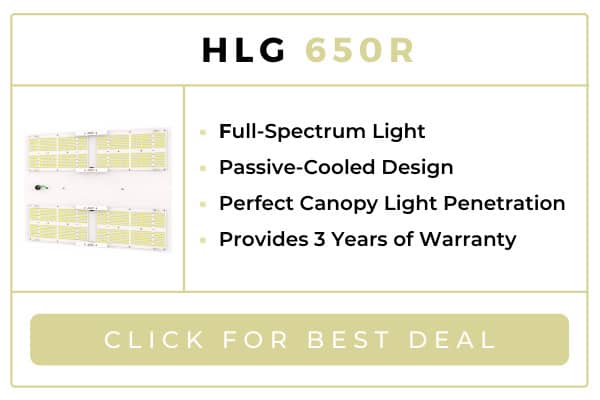
Horticulture Lighting Group's 650R is a premium, high-output fixture. It is powerful enough that it should hang well above the canopy in flowering, or it can bleach and crisp the top buds.
HLG has updated it over the years, so check the current spec sheet for:
- PPF, the total light output in µmol/s.
- Efficacy, how many µmol of light it makes per joule of electricity.
Now, let us look at the specifications.
Unmatched Light Efficiency and Spectrum of HLG 650R
The HLG 650R is designed as a replacement for a 1,000-watt double-ended HPS lamp.
It uses four white full-spectrum quantum boards with Samsung diodes plus 660 nm deep red.
It is dimmable, so you can turn it down for seedlings and young plants.
Like other modern white LEDs, it puts out a full spectrum that includes green and yellow, not just red and blue.
How Is This Helpful?
Warm-white diodes give off plenty of red light, which plants use efficiently, plus enough blue for compact growth.
Adding deep red increases the light plants use most efficiently in flowering. Far red can boost photosynthesis when paired with other light (the Emerson effect), but how much it helps cannabis yield is still being studied.
Claims that a given spectrum shortens flowering by a set number of days are not well supported, so don't buy on that basis.
What matters most is how much usable light reaches your canopy for each watt you pay for.
Features
Coverage
Spreading diodes over four boards gives fairly even light across the footprint.
Cooling Systems
HLG lights use a heat sink for passive cooling, with no fan to fail. You still need tent ventilation to remove the heat.
Key Specifications
- Replaces a 1,000W double-ended HPS
- Four quantum boards with 660 nm deep red
- Dimmable
- Passive cooling
- Check HLG's current spec sheet for PPF, efficacy, footprint and certifications
Verified and Lab-Tested
HLG publishes third-party test reports for its lights. Look for safety listings such as UL or ETL on any fixture you buy.
Review About the Official Website of HLG
HLG's website lists specifications, dimensions, output and manuals.
Pros
- Power can be dimmed
- Light penetrates onto a wider area with a diffused light option
- It comes with a built-in passive cooling system
Cons
- Plants may become crispy if lights are hung too close
#3. GHL’s Gavita Pro 1700e LED – Most Durable
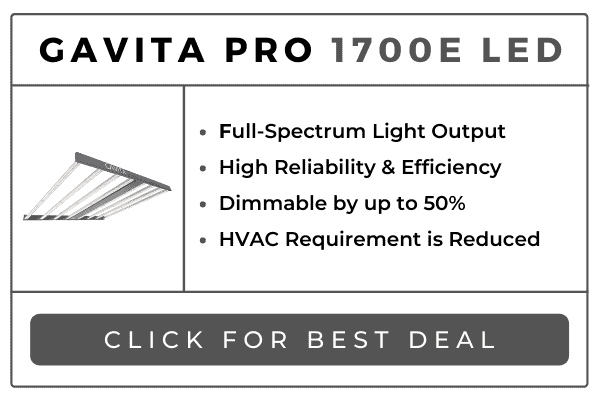
The Gavita Pro 1700e LED is a commercial-grade bar fixture. It no longer appears in Gavita's current lineup, which now lists models such as the Pro RS 2400e LED and RS 1900e LED, so you may only find it used or as old stock.
It is expensive, but it was built for commercial rooms and long service.
Running LEDs below their maximum current, as many commercial fixtures do, generally helps them last longer.
Features
Efficiency and Full-Spectrum
It was rated at about 2.6 µmol/J with roughly 1,700 µmol/s of output, figures in the model name. Today's top fixtures are more efficient.
It is made for indoor rooms and greenhouses.
Even Coverage
Its bars spread light evenly over the canopy.
Passive Cooling System
Its eight bars are passively cooled, so the fixture is silent. The room still needs ventilation or air conditioning to remove the heat.
Key Specifications
- About 645 watts
- About 1,700 µmol/s of light output
- Eight-bar design
- Dimmable, with an external controller option
Verified and Lab-tested
It was sold with horticultural safety certifications and a wet-location rating. Check the label on any used unit.
Review about Official Website
Gavita's website now features its newer fixtures, so look there for a current replacement.
Pros
- Suitable for use in wet environments
- Sealed against dust and water
- Silent, passively cooled bars
- Can be run from a central controller in larger rooms
Cons
- More costly than other brands
- Discontinued; hard to find new
Choosing the Perfect LED Grow Light Brand
The ability to pick and choose is an art. You have to be sensible enough to choose the best product for yourself, which is the case when selecting an LED grow light. Look for a durable, well-built fixture with a solid warranty.
Remember that grow lights run 12 to 18 hours a day. Growers typically keep plants under 16 to 18 hours of light in vegetative growth, per research in Plants, and switch to 12 hours for flowering. Efficiency directly affects your power bill.
Here are our reviews of the grow light selections from top brands:
- Kind LED Grow Lights Review
- ViperSpectra LED Grow Lights Review
- Mars Hydro Grow Lights Review
- GalaxyHydro (Roleadro) LED Grow Lights Review
- Advanced Platinum LED Grow Lights Review
- G8 LED Grow Lights Review
- Bestva 2000W Grow Light Review
- Quantum BadBoy T5 Grow Light Review
The following tips concerning product specification should be considered as a guideline before purchasing an LED:
- Spectrum
Most quality LEDs today use full-spectrum white diodes with added deep red. Older blurple (red and blue only) lights work but make it harder to see plant problems.
So, how can we check the genuineness of high-quality LED grow lights? It can be checked through PARS (Photosynthetic-Active-Radiations) and PPFD reports available on the renowned brands’ websites.
- Area to Be Covered and Len’s Angle
You can choose the best LED grow light only if you know the exact length of the area that needs to be covered. A lighting system must cover the range of the full area so it can reach every plant with its effects and potency, such as light spectrum, heat, coverage, and intensity.
The beam angle and any lenses decide how focused or spread out the light is. Check the PPFD map to see how even the coverage is.
- Wattage – The Measurement of Power
Checking out the light’s wattage before buying an LED can save you from future troubles. It is not wise to buy a high-wattage LED blindly, as it may not serve the intended purpose.
It would be best for you to purchase an LED with a wattage according to the area of the crop and the number of plants required. Buying more than you need is not wise at all. For a 2 x 4 or 3 x 3 tent, a quality light drawing around 200 to 300 watts is often enough. Use actual watts drawn, not the "equivalent" number in a product name. Therefore, the conditions of your farm will determine the wattage of your LED.
- Heat Output
Every watt a light draws ends up as heat in your grow space. Plan your exhaust fan or air conditioning around the light's actual wattage.
Hang the light at the maker's recommended height so it covers the canopy evenly without bleaching the tops.
- Lab Tests
Good brands publish independent test reports for PPF and efficacy, plus safety listings like UL or ETL. Be skeptical of brands that only publish marketing numbers.
- Return Policy and Warranty
One of the essential policies of good brands is the warranty of their products. In case something goes wrong with the product, the brand will compensate for the loss or damage of the product.
With a product, there is a specific period of time, during which if any defect occurs, the brand has to take it back and replace it or offer a refund. You must be aware of all such policies, as you will need them if the product does not work as expected.
- Cost
You will find a large variety of LED lighting systems to pick and choose from in the market. These include highly expensive ones, very cheap ones, and ones at an affordable cost. Always keep in mind, however, that the most expensive product may not necessarily be the best product.
You will also need to consider the cost of the increase in your utility bills that the LEDs will cause, along with the overall maintenance expenditures.
Features like light output, efficiency, and coverage are the necessary requirements. Cost and quality are also co-relative. So, you must compare and contrast different options before you decide to purchase an LED system.
Read Also: Best LED Bulbs for Grow Lights
Miscellaneous Common Factors
- Kinds of Plants and Their Growth Stages
There are different types of plants and their strains, and they all need different wavelengths of light for their different periods of growth.
Blue light keeps plants compact, while far red tends to stretch stems. Most of a plant's growth comes from the total amount of usable light, with red being used very efficiently.
- Indoor and Outdoor Requirements Vary
Indoor growers rely fully on artificial light, while greenhouse growers use LEDs to supplement the sun. Choose a fixture for how much light it must provide on its own.
- Types of LED Grow Lights
There are a number of types of LED grow lights from which to choose. These include COB grow lights, Quantum Board, Spider LED lights, Traditional Panel lights, and more.
Light Spectrum and Its Importance
How is it possible for you to understand the efficiency of the grow lights you have, or plan to buy? Well, most have the misconception that the efficiency and quality of grow lights depends on the lumens and wattage. Lumens measure brightness to the human eye, so they are a poor guide for plants. What matters is how many usable photons the light makes and where they land. Additionally, the light intensity matters a lot as well.
PAR, PPFD and efficacy (µmol/J) are the numbers that matter.
Let us make it easier for you to understand.
Outdoors, the sun supplies far more light than most indoor setups. Indoors, you need to know what PAR and PPFD mean.
- PAR and Its Importance
PAR stands for photosynthetically active radiation, the light between 400 and 700 nanometers that plants use for photosynthesis.
Photosynthesis is how plants make sugars from light, water and carbon dioxide.
So, they design their LEDs in such a way that they include the most essential wavelengths such as:
- The wavelengths required for the Vegetative Growth (ranging from 400nm to 500nm)
- The wavelengths required for flowering (ranging from 620nm to 700nm)
The LEDs are made in such a way that they promote vegetation and flowering processes.
HPS grow lights still grow good cannabis, but they put out mostly yellow-orange light, waste more energy as heat and need bulb replacements. LEDs are generally the more efficient choice today.
However, PAR is not the only thing you need to get healthy plants. This is where PPFD plays its role.
- PPFD and Its Importance
PPFD, or photosynthetic photon flux density, is how many photons of PAR land on a square meter each second (µmol/m²/s).
- Seedlings and clones do well under gentle light.
- Vegetative plants can use more.
- Flowering plants can use a lot: in one study, yield kept rising up to 1,800 µmol/m²/s at canopy level, though growers without added CO2 usually run lower.
Raise light gradually and watch for bleached or curled top leaves, a sign of too much light.
A lot of other factors like temperature and level of carbon dioxide matter as well.
- Red Light Wavelength
Red light (roughly 600 to 700 nm) drives photosynthesis very efficiently in all stages.
Red alone is not enough for normal growth, so lights pair it with blue or white.
- Blue Light Wavelength
Blue light (400 to 500 nm) drives photosynthesis and keeps plants compact.
Too little blue tends to make plants stretch, with long gaps between nodes.
Some lights let you adjust red and blue channels separately for different growth stages.
- Ultraviolet Rays
Ultra-violet radiations below 400nm generally include long-wave, Ultra-violet-A (315nm to 400nm), short-wave, Ultra-Violet-B (280nm to 315nm), and UCV (180-280nm). The latest LED grow lights usually contain some Ultra-violet ranged bulbs/diodes.
UV is often claimed to raise THC, but research has not shown a reliable benefit, and it is not needed to grow good cannabis.
UV can damage your eyes and skin, so wear UV-blocking eye protection and switch UV channels off when working under the light.
- Infrared Rays
Far red (about 700 to 750 nm) is at the edge of what we can see. Plants sense it through pigments called phytochromes, which affect stretching and flowering.
Longer infrared mostly adds heat and does not drive photosynthesis.
Using LED Grow Lights to Grow Cannabis Plants
Cannabis needs plenty of light, the right light schedule and a good environment, especially in flowering.
LEDs aim their light down at the canopy instead of in all directions, so less is wasted on walls and ceilings.
Pair them with reflective walls for the best use of each watt. Plus, you can automatically control the quantity of light with one of the best grow light timers.
Choosing the most suitable lighting option depends on what you are doing and the lighting system you need, however, our first recommendation is Spider Farmer SF Series. A quality LED is a good investment for a home grow. Potency comes mostly from genetics, with light, environment and harvest timing also playing a part.
Sources
- Spider Farmer SF1000 product page and SF series comparison, Spider Farmer
- Cannabis Yield, Potency, and Leaf Photosynthesis Respond Differently to Increasing Light Levels in an Indoor Environment, Frontiers in Plant Science (via NIH PMC)
- Examining the "Night Break" Method in Cannabis sativa Horticulture, Plants (via NIH PMC)
- Gavita product lineup, Gavita