How to Make Cannabutter (With Ease)
Contents
Photo by Realclark at English Wikipedia, Public domain, via Wikimedia Commons
In this cannabutter guide, I'll show you how to make cannabis butter with very little equipment. We'll cover how to decarboxylate weed, optional water curing, and how to cook and dose cannabutter.
This guide is for adults 21 and older in places where cannabis is legal. You can also use coconut oil or another cooking oil instead of butter, in the same amount.
To start, here's what you'll need.
Things you'll need:
- Oven
- Baking tray and baking paper
- About 20:1 butter (or oil) to cannabis by weight: 200 grams of butter for 10 grams of cannabis, or about 1 pound of butter (4 sticks) to 1 ounce of cannabis. It doesn't need to be exact.
- Pot or saucepan
- Water
- Grinder
- Cheesecloth or fine mesh strainer
- Container for the finished butter, with a label
Water curing (optional)
Water curing can reduce the strong grassy, herbal taste some people dislike. You can do it before or after decarboxylating.
How to water cure weed:
- Put the cannabis in a glass jar with clean water.
- Shake and let it rest for 30 minutes to an hour.
- Strain out the colored water.
- Refill with fresh water and repeat until the water stays mostly clear, which can take a few hours.
- Drain the water and dry the cannabis in a low oven before using it.
Decarboxylating
Decarboxylating means heating cannabis so that it becomes active in edibles.
Raw cannabis contains mostly THCA, which isn't intoxicating like THC. Heat converts THCA into THC. A study of cannabinoid decarboxylation found that THC forms mainly by heating its acid form, THCA, and that the conversion runs faster at higher temperatures.
Here's how to decarboxylate weed for edibles:
- Break up the buds and spread them on a baking tray lined with baking paper.
- Set the oven to around 220°F (105°C). Avoid very high temperatures, which can scorch the cannabis.
- Bake for 30 to 45 minutes. Lean toward the longer time if the buds aren't ground.
- Let it cool. It should look light brown or toasted.
- Grind or crush it if you haven't already.
Cannabutter Recipe
Once your cannabis is decarboxylated, you're ready to make the butter.
Here's how to cook cannabutter:
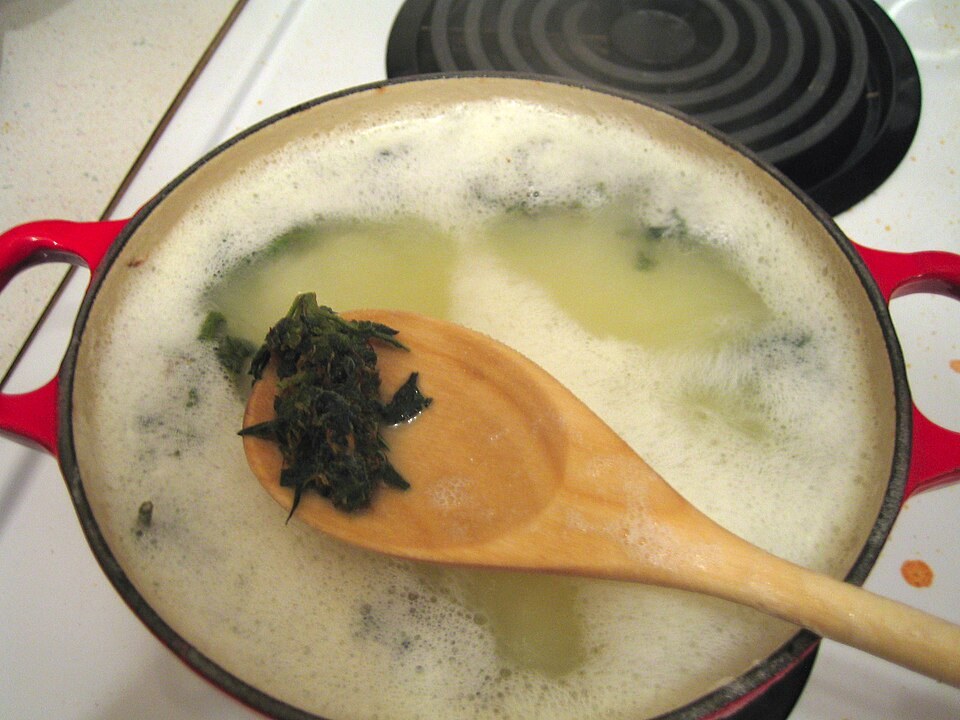
- Add water and butter to a pot in roughly equal amounts, for example 1 cup of each. The water helps keep the butter from scorching.
- Bring the water to a boil, then add the butter and cannabis and turn the heat down to low.
- Cover and keep it at a gentle simmer, around 180°F (80°C). Don't let it boil.
- Cook for 2 to 3 hours, stirring now and then.
- Remove from heat and let it cool until warm.
- Pour through cheesecloth or a fine strainer into your container.
- Refrigerate until the butter hardens, then pour off any water underneath.
- Label the container clearly as cannabis butter and store it where children and pets can't reach it.
You can use cannabutter in brownies, cookies or other recipes.
Test a small amount of your butter before baking with it, since every batch is different. Edibles can feel much stronger and last longer than smoking.
Cannabutter FAQs
Why is the high from weed edibles so much stronger than smoking?
When you eat cannabis, your body processes THC more slowly than when you inhale it, and the THC passes through your digestive system and liver first. Smoked cannabis contains many different cannabinoids too, but the route of intake changes how the effects build.
California's Department of Cannabis Control says edibles can take up to two hours to begin working and up to four hours to reach full effect. Its advice is to start low and go slow.
NIDA warns that because edibles take longer to kick in, people may take more while waiting, which raises the risk of serious negative effects.
That's why it's a good idea to test a small amount of cannabutter on its own, for example on toast, before baking a batch.
If a small amount is plenty for you, use less butter per serving in your recipe. If a batch is too strong, you can melt it and mix in plain butter.
Read Also: What is Bubble Hash
Are there any easier ways to making cannabis edibles?
Yes, but they cost more. Countertop infusion machines such as the Magical Butter machine and the Levo oil infuser automate much of the process. Check each maker's instructions for whether you still need to decarboxylate first.
If you don't want to buy a machine, the stovetop method above works well with basic kitchen tools.
Read Also: How to Use Cannabis Oil
Cannabis Edibles Potency Calculator
You can estimate the potency of your butter with a simple formula. It is only an estimate, because THC content varies by batch and not all of it ends up in the butter.
You'll need the THC percentage from the product label. Homegrown cannabis without lab testing can't be calculated accurately. We'll call the formula PASER:
- P = Potency of weed (15% THC = 0.15, 20% = 0.20, etc.)
- A = Amount of weed used, in grams
- S = Servings. If you make 10 brownies with the whole batch of butter, that's 10 servings.
- E = Efficiency of extraction, an assumed value. We'll use 80%, or 0.80.
- R = Result, in grams of THC per serving
So, P * A / S * E = R
If you use 5 grams of 15% THC cannabis and make 8 brownies with all the butter:
0.15 (Potency) * 5 (Amount) / 8 (Servings) * 0.80 (Efficiency) = 0.075 grams of THC per brownie.
That's an estimated 75 mg of THC per brownie, which is very strong. For comparison, start with a much smaller portion and wait at least two hours before eating more.
Closing Notes
That's a simple guide to making cannabutter. Start with a small dose and wait, because edibles can catch even experienced users off guard.
Label your butter, keep it in a child-resistant container, and store it out of reach. NIDA notes that children eating cannabis edibles is a growing health concern that can lead to hospitalization. In an emergency, call Poison Control at 1-800-222-1222.
Edibles are only legal for adults 21 and older where state law allows. Under US federal law, marijuana remains a Schedule I controlled substance outside narrow exceptions, and state laws differ.
Sources
- Decarboxylation Study of Acidic Cannabinoids, Cannabis and Cannabinoid Research (via Europe PMC)
- Responsible cannabis use, California Department of Cannabis Control
- Cannabis (Marijuana), National Institute on Drug Abuse
- Schedules of Controlled Substances: Rescheduling of FDA Approved Products Containing Marijuana From Schedule I to Schedule III, Federal Register (U.S. Department of Justice, DEA)