Best Soil pH Testers for Growing Cannabis
Contents
- Popular pH Meters for Growing Cannabis
- 1. Sonkir 3-in-1 Soil pH Meter
- 2. Atree Soil pH Meter
- 3. Hofun Soil pH Meter
- 4. Goksu Soil pH and Moisture Meter
- 5. Veroyi Soil pH Meter
- What to look for in the best pH meter?
- Types of pH Meters
- Readout Scale
- Advanced Detection Technology
- Ease of Use
- How Accurate are pH Meters?
- Final Words
- Sources
The structure of the growing medium ensures good porosity and superior root growth. The next important aspect of your growing medium is soil pH and how it affects your marijuana plants.
pH measures how acidic or alkaline something is, based on hydrogen ions. In soil, it controls how available nutrients are to your plants' roots.
One warning up front: many devices sold as soil pH meters do not really measure pH. UC Agriculture and Natural Resources says only a few do, and recommends litmus strips or a digital meter with a bulb-shaped probe, with a lab test being the most accurate.
The five battery-free 3-in-1 probes below are handy for checking moisture and getting a rough idea of soil conditions. For pH numbers you act on, confirm with a calibrated digital meter or a lab test.
Our top pick among these probes is the Sonkir 3-in-1 Soil pH Meter. This guide is for adults 21+ growing where it is legal.
Popular pH Meters for Growing Cannabis
1. Sonkir 3-in-1 Soil pH Meter
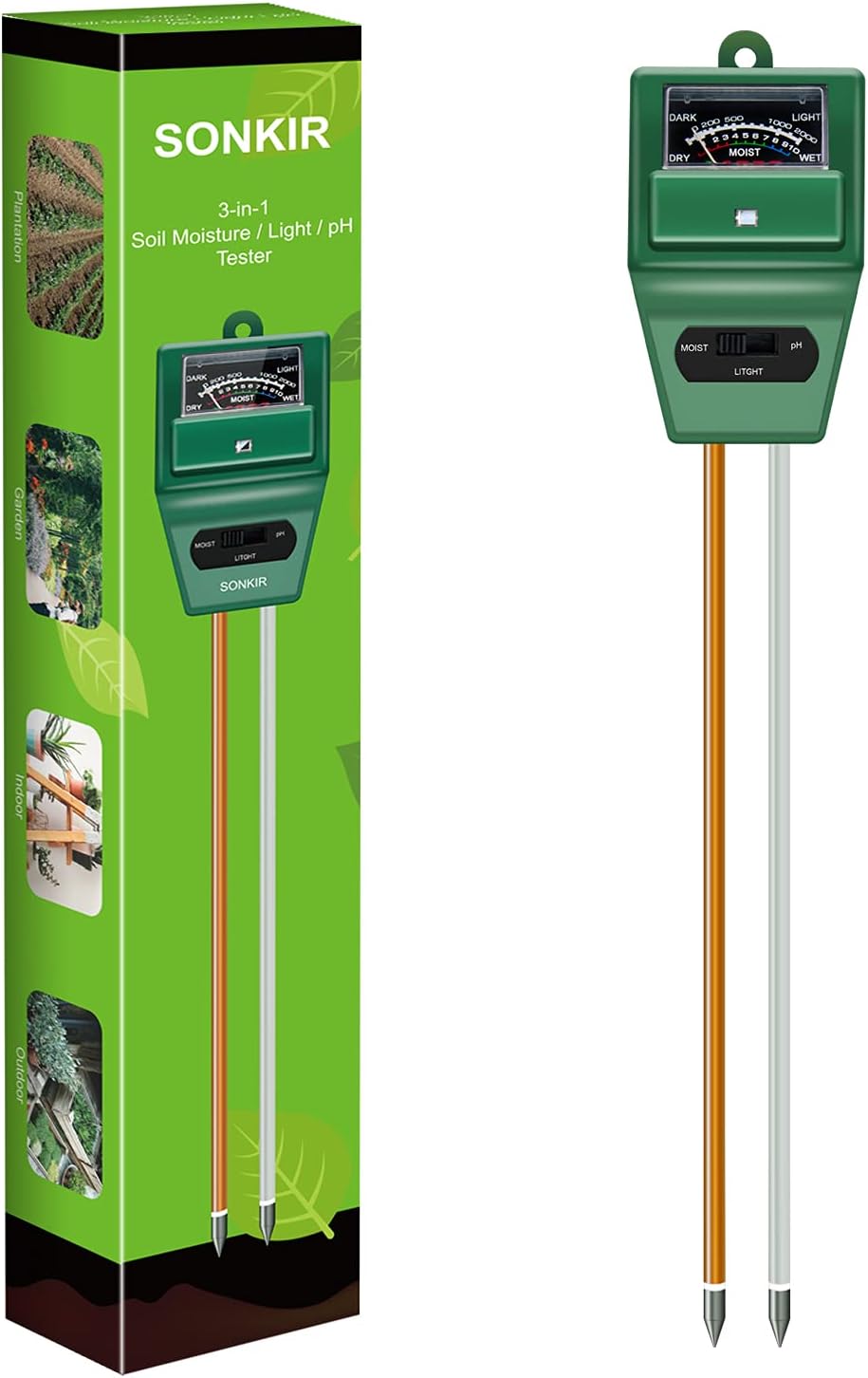
If you want a model that is versatile, but still easy to understand, then the Sonkir Soil pH Meter is a great choice for your weed plant care. It has a simple dial that shows a pH scale, a moisture scale and a light reading.
Its moisture reading is the most useful part, telling you when soil-grown plants need water.
On top of that, the Sonkir pH meter also gives a rough light reading.
Treat its pH reading as a rough indicator only. Probe-type testers like this are not a substitute for a calibrated digital meter.
Things We Like:
- Three-in-one functions eliminate the need for more than one device
- Easy-to-read dial
- Battery-free
- Useful moisture reading
- Lightweight design is suitable for indoor and outdoor cannabis plants
Things We Didn’t Like:
- pH reading is approximate; does not work in dry soil or liquid nutrient solution
2. Atree Soil pH Meter
Make your dream weed garden come true with the Atree Soil pH Meter. This is a three-in-one soil meter with pH, light and moisture functions.
The scale is easy to read. Remember that 7 is neutral, below 7 is acidic and above 7 is alkaline.
Moisture readings in the red part (1-3) indicates the soil is dry, green part (4-7) indicates the soil is moist, and blue part (8-10) indicates the soil is wet.
The light sensor gives a rough reading. It is far too limited to judge grow lights, which need a PAR or PPFD meter.
It is easy to use: push the probe a few inches into moist soil and switch between modes.
Wait for a few minutes, and then adjust the switch to note the soil pH, moisture and light. Remove the probe from the soil and wipe it clean after use.
Things We Like:
- It is a 3-in-1 pH meter
- Easy readout scale with simple to decipher calibrations
- Doesn’t need special skills to use, just insert into the soil
- No electricity or batteries are needed for operation
- pH reading is a rough guide only
Things We Didn’t Like:
- Light sensor may not be useful
3. Hofun Soil pH Meter
Do you want a pH kit that helps to improve plant care? Look no further than the Hofun Soil pH Meter. This is a 3-in-1 probe for testing pH, light, and moisture.
You will love it on your garden and farm. It is particularly great in the house in your potted weed plants. It comes with an easy-to-read scale for pH, moisture and light.
The unit comes with three sensors. The light sensor is located just below the scale, which helps you to establish whether your weed plants are getting sufficient light.
The moisture sensor tells you when soil-grown plants need water. It is not for hydroponic systems, since it reads soil, not nutrient solution.
Like the other probes here, its pH reading is approximate. Confirm with a digital meter before amending soil.
Things We Like:
- Three-in-one soil meter for pH, moisture, and light
- Easy to decipher readout scale
- Moisture sensor alerts you when to water the weed plants
- No electricity or batteries are required
Things We Didn’t Like:
- May fail to find the usefulness of the light sensor
4. Goksu Soil pH and Moisture Meter
The Goksu Soil pH and Moisture Meter is ready to use out of the box. It is a handheld device that is extremely easy to use. The unit has a heavy-duty body that can take a beating. Its metal probe reads moisture and gives a pH estimate. It does not measure light.
It has a simple dial and needs no batteries. It works best as a quick moisture check for potted plants.
Installing the meter is super easy. All you have to do is push it into the growing medium until all the metal rings are sunken. The depth is approximately 2 inches.
Things We Like:
- Simple moisture/pH switch
- Easy readout
- No batteries necessary
Things We Didn’t Like:
- Doesn’t penetrate deep enough into the soil
5. Veroyi Soil pH Meter
The Veroyi Soil pH Meter is a highly versatile soil tester that can be used indoors as well as outdoors to improve weed plant care. It features three functionalities in a single unit, including pH levels, moisture levels, and light intensity received by your plants.
What is truly impressive about this unit is the simple design. No batteries or electricity needed to operate it, just insert it into the soil and it will do the rest.
A switch toggles between pH, moisture and light, shown on a simple dial.
As with the other analog probes, use its pH reading as a rough guide and its moisture reading for watering.
Things We Like:
- Easy readout
- Simple design, no electricity/batteries required
- Lightweight and compact for indoor and outdoor use
- Three-in-one function eliminates the need for separate tools
Things We Didn’t Like:
- May receive defective pH meter
What to look for in the best pH meter?
The best cannabis soil should still be pH-tested now and then. pH that drifts too far makes some nutrients unavailable, which can show up as deficiencies. Here are a few things that you can consider before you engage the market.
Types of pH Meters
The main choice is between analog probe testers, like the five above, and digital pH meters with a glass bulb electrode.
Analog 3-in-1 probes are cheap, battery-free and good for moisture checks, but their pH readings are rough. Digital meters need calibration and care, but they actually measure pH and can test both soil slurries and hydroponic nutrient solution.
If you grow in hydroponics or coco, you need a digital meter or test drops, since soil probes cannot read liquids.
Readout Scale
The size and calibration of the readout scale are very important. You must be able to view the pointer and be able to decipher the readings.
On any pH scale, 7 is neutral, lower numbers are acidic and higher numbers are alkaline.
Each whole number is a tenfold change. Soil at pH 6 has 10 times the hydrogen ions of soil at pH 7, per UC ANR.
For hemp grown in soil, Utah State University Extension gives an ideal pH of about 6.0 to 7.0. In hydroponics, most crops grow well between 5.5 and 6.5, per New Mexico State University.
Advanced Detection Technology
For real pH readings, look for a digital meter with a replaceable glass electrode, automatic temperature compensation and two- or three-point calibration.
Buy calibration buffer solutions (usually pH 4.0 and 7.0) along with the meter, and store the probe in storage solution, not plain water.
Ease of Use
Any quality pH meter for weed you buy should be easy to use. Battery-free probes are the simplest, but simplicity comes at the cost of accuracy.
For soil pH, a good home method is to mix a soil sample with an equal amount of distilled water, let the slurry sit 15 minutes, stir, then measure with a calibrated meter, per UC ANR.
How Accurate are pH Meters?
The major problem with most pH meters is that readings drift if the meter is not calibrated regularly. UC ANR notes that inexpensive meters can arrive with incorrect calibration, so calibrate with solutions of known pH before first use.
Depending on the cost of the instrument, it may give pH readings to the nearest 0.1 or 0.01 pH unit, although the latter is unlikely to be required in most applications.
Most pH meter probes have a life of one to three years and need to be replaced. Otherwise, they may end up giving incorrect readings.
Final Words
A cheap probe tells you roughly where your soil stands, and a calibrated digital meter or a lab test tells you precisely. Use both if you can.
pH matters because it controls how well your plants can use the nutrients you give them.
For an easy, battery-free probe, the Sonkir Soil pH Meter is our pick. Pair it with a digital meter before you amend soil.
The moisture sensor on a 3-in-1 device is the most useful part for deciding when to water. The light sensor is only a rough check.
Sources
- Adjusting Soil pH in the Garden, UC Agriculture and Natural Resources
- Ten Frequently Asked Questions About Growing Cannabis, Utah State University Extension
- Hydroponics: Water-saving Farming for New Mexico's Arid Environment, New Mexico State University